A magical girl webcomic from the point of view of the villains.
Updates on the first Friday of every month.
About the Story:
To Prevent World Peace is a magical girl story . . . from the point of view of the villains. Someone has to save the world from overpowered magical girls!
About the Author:
Hi! I'm Emily Martha Sorensen. I write clean young adult, middle grade, and adult fantasy. You can find an easy link to all my books here.
Happy, optimistic stories are my wheelhouse. As such, I started A Magical Roommate during my first year of college. Soon afterwards, I decided I wanted to do a magical girl series. But what could I do that hadn't been done before? Hmm . . .
"I know! I'll tell a magical girl story from the point of view of the villains! I love looking at things from unusual points of view!"
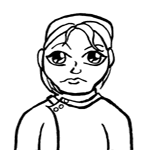
Kendra used to be a magical girl . . . until she learned that her most likely future included destroying the world. Now she's a villain, taking down corrupt magical girls in order to purify the magic system. She is sixteen.
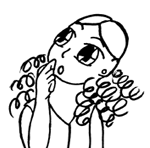
Chronos is a born mage who was born into a powerful villain family. She can see the future, which isn't always convenient. She's thirty-three.
Tiffany has lived in the dungeon since she was four years old. Raised by villains, she has a rather bizarre sense of morality. She creates nifty weapons and defenses that work only because her magic makes them. She's now ten years old.
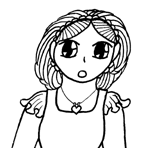
Rhea is a fashion designer who specializes in manipulating magical girls to turn evil. She is extremely dangerous, and easily underestimated. She's thirty-five, and Chronos's big sister.
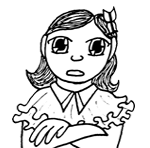
Florence is Kendra's best friend, and used to be her teammate. She's currently the leader of the Magical Girl Union. She is sixteen.
Other Characters:
Felicity was Kendra's other teammate. She quit after Kendra left, and is now dating the boy she used to have a stalker-crush on. She is fifteen.
Minerva is Rhea's two-faced minion. She's usually sassy, but Rhea forces her to act and dress conservatively at work. She's a front for non-villain customers. She's twenty-three.
Eloise Santos was the president of Mágico, a new country in South America. She was a leader in their revolution, and helped Florence set up the Magical Girl Union. She's twenty-one, and kept her powers as late as eighteen.
Rafael Bianchi is the current president of Mágico. He's not particularly interested in the Magical Girl Union, and is leaving Florence to manage it alone. He's fifty-eight.
Magical Girl Union:
Dulcina Caramelo is an extremely powerful fighting magical girl. She has not detransformed in ten years, and fails to see the point of any personal life. Her crusade is to protect homeless children in Mexico City (of which there are far too many). She's seventeen.
Snowbelle is a very popular Antarctican magical girl. Like most Antarctican magical girls, she has temperature powers, including an ice slide for fast traveling. She loves doing commercials, and is a skilled teacher. She speaks with an Australian accent, and is twelve years old.
Chung-Ae is the leader of the Righteous Army, an underground organization that seeks for Korea's freedom from Japanese rule. One of her powers is to teleport notes and letters written to or from her. She is still a magical girl at the age of nineteen, which is extraordinary.
Chin-Sun is an ambassador for Chung-Ae, the leader of Korea's Righteous Army. She has shapeshifting powers and can speak quite a number of languages. She's seventeen.
Schönneswasser is a German magical girl from Berlin, right near the heart of the magical girl magic system. She has tracking powers that work as long as people stand still. She's thirteen.
Météore is a very shy French magical girl who speaks with a stammer. She has shooting star powers, including a tiny meteor that orbits her, but she rarely uses them. Her most useful power is that she can tell when people are lying. She's fourteen.
Xinghuo is the official representative for the tienlong, China's semi-military magical girl organization. She's sixteen.
Namikaze Tateru is the polar opposite of an official representative of the kamikaze, Japan's semi-military magical girl organization. She dislikes the Japanese emperor and is very outspoken about it. She would probably be killed if she went back to Japan. She's sixteen.
Golden Tingle Spray is an English magical girl who's strongly in favor of mascots. She thinks they need more aid and support from the magical girl community. She's thirteen.
Jeanne d'Rouen is a French magical girl who dislikes mascots, seeing them as beggars who could learn to solve their problems themselves. She's a huge fan of Jeanne d'Arc, and she grew up and went to school in Rouen. She's fourteen.
Asiyah Azhaar is a very gentle magical girl from Saudi Arabia. Her powers are purely protection and healing based. She is thirteen.
Princesa is a Peruvian born mage magical girl who gets very defensive about born mage discrimination. She's thirteen.
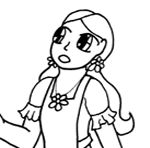
Edelweiss is an Austrian singing magical girl. Her powers include summoning and growing flowers, plus also a magically perfect voice, a power most singing magical girls have. She is fourteen.
La Rama Fragrante is a healing magical girl from Argentina. She volunteers at hospitals across the nation, and while she doesn't know enough about anatomy to assist in things like surgeries, she's often used to stabilize accident patients in emergencies. She's fifteen.
Delicate Frost Princess was one of Snowbelle's students. She's widely considered the second-most powerful magical girl in Antarctica, and of course she has frost powers. She's fourteen.
Mellie is a minor actress from Melbourne, and she has one of the most uncreative magical girl names ever. Her human name is Melinda Schwartz. She gave herself the magical girl name when she was five.
Fecskefarkú Lepke is a Hungarian magical girl with flight powers. She usually transports the other European magical girls to and from Mágico for Magical Girl Union meetings.
Léon is the born mage accountant for the Magical Girl Union. He does not understand all of these teenage girls, and they kind of freak him out a little. He's thirty-six.
About the Setting:
Kendra's world is not ours. At first glance it probably seems similar, and with good reason. But the differences between her world and ours go quite a bit deeper than "it's our world, with a magic system thrown in."
Her world is an alternate universe of our own. Anything before the twentieth century was identical; the first difference came about a decade into the century, when a child moved into this world from a different one altogether. Sunny (Sönnig, in her native language) was the world's first magical girl, and she created the magic system all other magical girls use. No one knows how she did it; she wasn't in any condition to explain afterwards.
As a direct result of Sunny's actions, World War I (the Great War, in this world) ended early, in a stalemate. Because Germany was not forced into economic crisis from war reparations, the Nazi party never gained a following, and there was no World War II. In fact, since Sunny herself was German, Germany was the historical center of the magical girl magic system, and it is still considered a center of world power and moral virtue.
Not everything in this world's history is an improvement on our own. Magical girls tend to be a force for both peace and stability -- or, as villains would claim, "stasis and stagnation." Russia, China, and Japan have remained imperial, and Japan and China are perpetually at war with each other. In Russia, magical girls are recruited into public service as domovoi; in Japan and China, magical girls are conscripted into military service as kamikaze and tienlong. In Korea, magical girls are currently struggling for independence from Japanese rule through the Righteous Army.
Brazil is the major military power of South America, and its rule is not always benign. Because of this, about five years ago, a small piece of Brazil declared independence and successfully broke away. This new country calls itself Terra de Liberdade e Mágica, or "Land of Freedom and Magic," and it is generally referred to as "Mágico" because of its extremely strong emphasis on magical girls. While Germany remains historically important, Mágico is rapidly replacing it as the cultural center of the magic system.
Australia is the world's major exploratory power. It currently remains the only country to have sent astronauts into space, to have opened trade negotiations with countries in other worlds, and to have colonized Antarctica. Because Australia is an English-speaking country, English is as commonly spoken in this world as our own. However, America and England are both only moderately important on a global scale, and Australia is no longer a British colony.
Aside from technology that is generally behind ours -- there are no computers and very few cellular phones, for example -- North America is fairly similar to our world. Feminism gained ground more quickly, and segregation ended a bit later, but they happened at around the same time. Canada is independent from Great Britain, and they ban alcohol under Prohibition. (Prohibition never happened in the United States.) Both governments encourage magical girls to volunteer with law enforcement, and both have lower crime rates because of this.
Joan of Arc is the Catholic patron saint of magical girls. In France, she is called the "sainte des saintes," because the French word for "magical girl" is sainte ("holy one" or "saint").
In Germany, magical girls are called Sönnigkindern ("Sunny children"), in honor of the person who began their magic system.








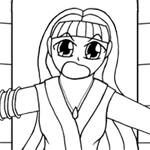


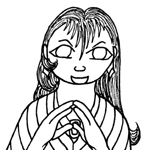
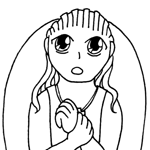

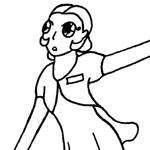
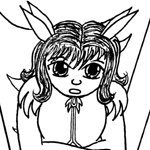
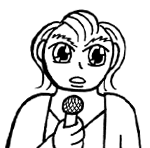
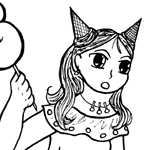

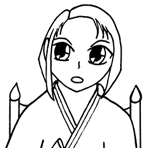

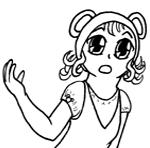
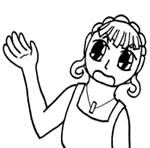
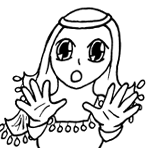
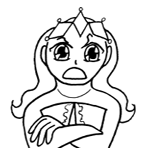
 Edelweiss is an Austrian singing magical girl. Her powers include summoning and growing flowers, plus also a magically perfect voice, a power most singing magical girls have. She is fourteen.